Best Places to go Shopping in Berlin

Shopping in Berlin

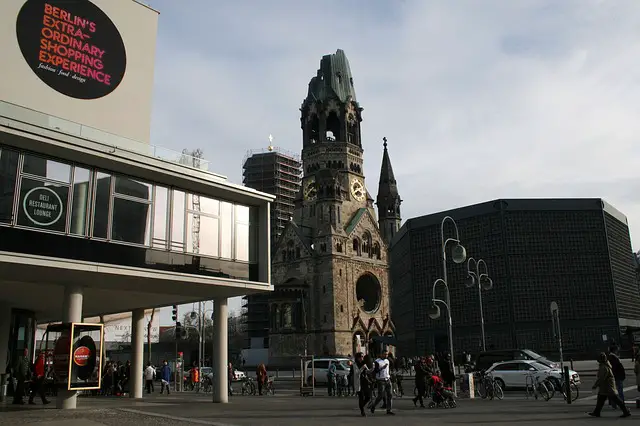
Berlin offers one of the greatest shopping experiences in the world with a diverse range from Luxury to Flea markets in terms of shopping escapades. Though online shopping is a convenience almost everywhere now, but sometimes finding an interesting piece at a flea bargain is a better deal than coupons!

Here is a consolidation of the most popular destinations offering everything from clothing, art to furniture and christmas decorations for shopping in Berlin.

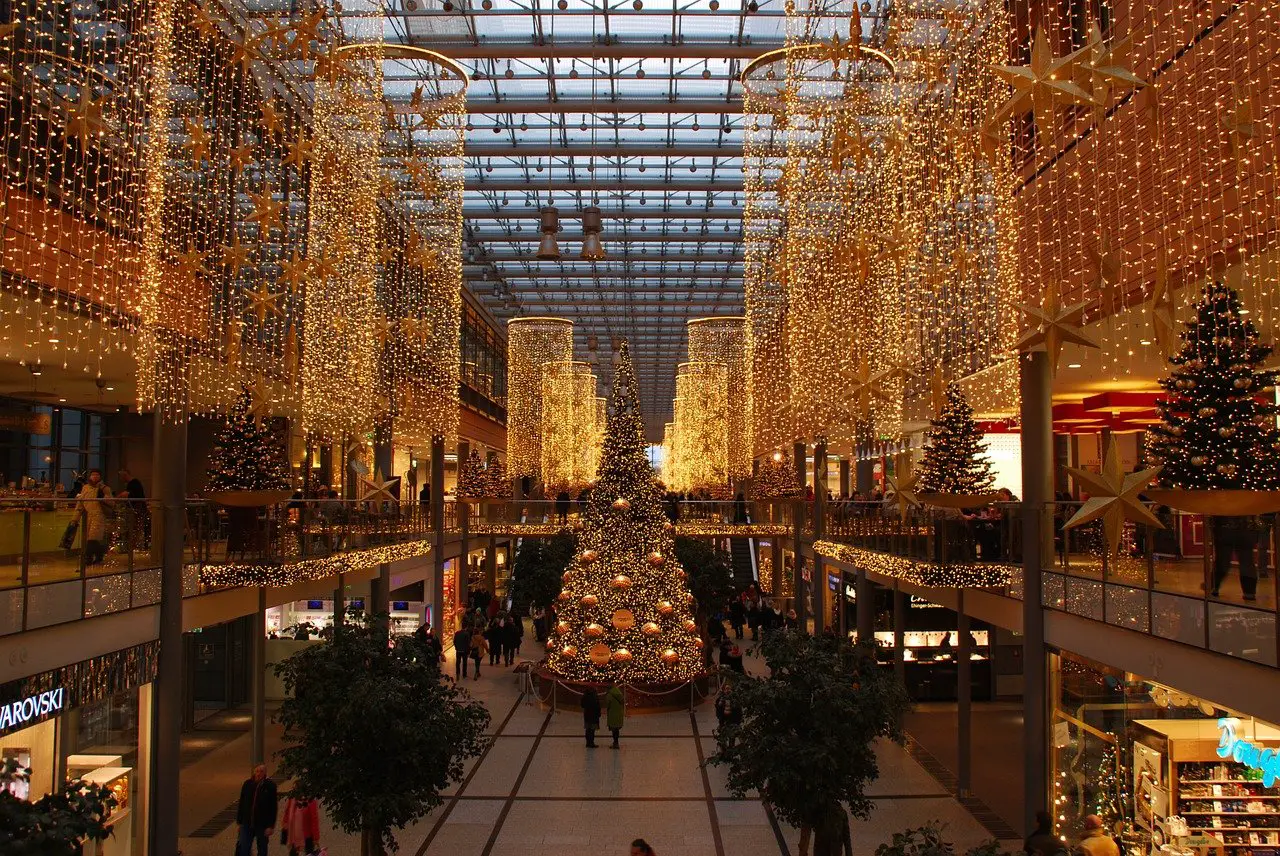
Mall of Berlin

The mall has almost all popular brands such as H&M, MAC, Calvin Klein, Adidas, Armani Exchange, Gap, Esprit, Fossil, GANT, GUESS USA, Hollister, Hunkemoller, Jack & Jones, Levi’s, Lacoste, Mango, Muji, Nike, Tommy Hilfiger, Tom Tailor, Zara and more.

It also has a wide variety of Berlin’s top premium brands including big players such as Sportscheck and Wormland Store, both of which extend over three complete floors.

You will also find popular fast food chains such as McDonalds, KFC and Pizza Hut here.

Mall of Berlin

Along with these stores utility services such as daily needs stores Aldi, Edeka and DM drugstore are available for every day shopping.

There’s a pharmacy – Leipziger Platz open every day until 8 p.m. which can be found directly at the piazza entrance in the direction of Leipziger Straße.

Mr. Souvenir – is the souvenir shop for every visitor to Berlin. But it is very useful for local Berliners as well, as the store offers tickets for various local attractions in advance – from Madame Tussauds to Sea Life, Legoland and Body Worlds to the GDR Museum. Something for all!

Side Note: This place has partnered with stores for Tax free shopping for tourists! International travellers, who live outside the EU have the option of having German VAT reimbursed by acceptance partners with almost all major international chains!

The Mall is located at Leipziger Straße 12, 10117 Berlin.

Bikini Berlin

The concept does not include large chain stores and instead, you will find a lot of stores and shops which have not yet shown a wide presence in Berlin or even in Germany. You will find everything from high-quality fashion and shoes here to modern design.

The Bikini Haus is a listed ensemble of buildings from the 1950s. It gets its name from its unusual architecture with an open colonnade in the middle.

It is located at Budapester Str. 38-50, 10787 Berlin, Germany.

Bikini Berlin

Kurfürstendamm

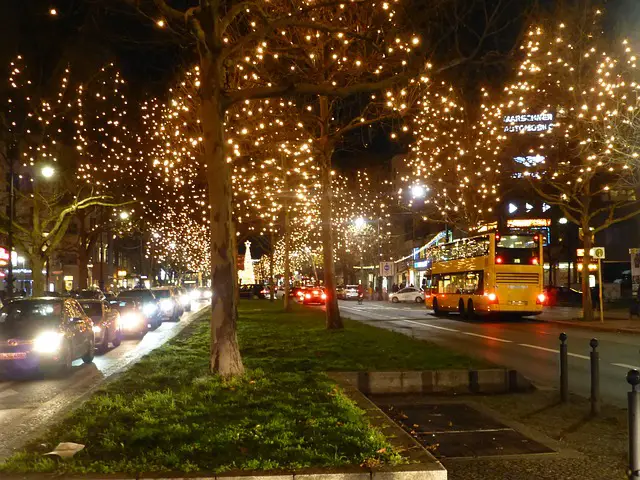
Kurfürstendamm is Berlin’s most famous and popular shopping boulevard. It is home to the flagship boutiques of the most luxurious fashion houses such as Hermès, Valentino, Chanel, Versace, Louis Vuitton, Prada, Burberry, and Gucci.

It is also home to “KaDeWe” (Kaufhaus des Westens – the ‘Department Store of the West’), the best-known department store in Germany. It is the largest sales store on the European continent. First opened in 1907, this store offers an attractive mixture of upmarket and luxury goods.

Kurfürstendamm

Store Opening hours:

  • Monday to Thursday 10:00 – 20:00
  • Friday 10:00 – 21:00
  • Saturday 9:30 – 20:00

Flea Market shopping in Berlin

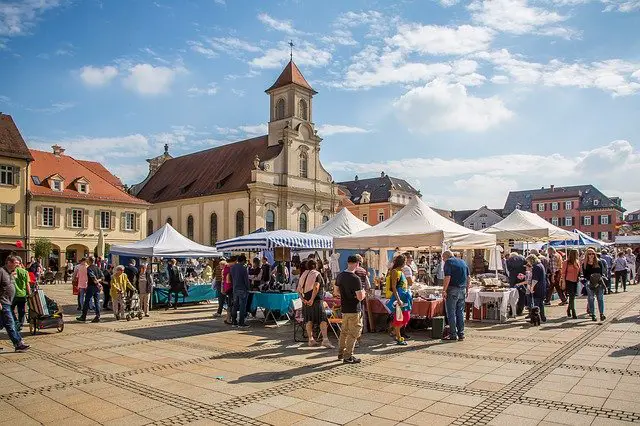
If you’re looking to thrift shop or want some antiquities, Berlin’s flea markets offer a great shopping experience. You can freely browse through an endless range of items – from furniture to clothing and antiques – and enjoy the pleasure of getting a great deal while having some amazing street food from the market.

Some of the well-known flea markets in Berlin are:

The Berlin flea market is one of the most famous antique markets in Berlin, offering nearly everything from second-hand items and handicraft to art and design objects. All you need are top notch bargaining skills to bag some interesting pieces with a cool background story!

Opening hours:

  • Saturday 10am–5pm
  • Sunday 10am–5pm

The market has over 120 antique dealers offer furniture, art, design items and books. Everything from furniture to art to war memorabilia is available at this Sunday antique market. Additionally it offers, many fast food restaurants, with German, Asian and Turkish cuisine. It is the ‘nostalgic’ feels market where you can find old postcards, books, cutlery and many modern stuff like fridge magnets featuring old East German propaganda graphic motives.

Opening hours:

Sunday 9am–4pm

Every second Sunday of the month, Prinzessinnengärtenin Kreuzberg turns into a flea market for design lovers of second-hand items, art, clothes and music.

Opening hours:

Sunday 10 am– 5 pm

Located at the historic Arminius indoor market in the Berlin-Moabit neighbourhood, Artminius21 is a great place to discover art, handicraft, design products and beautiful textiles.

This is a Christmas market to let you find gifts and decorations from about two Saturdays before Christmas. Merry Shopping!

Opening hours:

Saturdays 10 am – 5 pm

The art market at Zeughaus near Museum Island offers Artwork at affordable prices. The market offers a bohemian vibe with live demonstrations by local artists. Every weekend, the market is a popular spot for tourists and locals.

Opening hours:

  • Saturday 11am–5pm
  • Sunday 11am–5pm

Hospitals and Clinics in Berlin for expats

hospitals and clinics in berlin

If you’re not comfortable with German so much to explain, you can simply switch to practitioners who could communicate in your language.

Doctena is a website which lets you find doctors of any specialty based on the language you prefer and book an appointment! There are other websites too such as Docinsider, which shares information about local doctors and medical centers in Berlin and also other German cities.

The Top Hospitals and clinics in Berlin that offer assistance in multiple languages such as English, Russian, Arabic, or French are:

HELIOS Kliniken Berlin-Buch  

The Helios Clinic Berlin-Buch is one of the largest clinics in Berlin with a capacity of more than 1000 beds arranged in about 30 clinics, centers and institutes. Because of intertwined Outpatient care and inpatient care and close cooperation the patient has access to all aspects of comprehensive medical care in one location.

  • Address: Schwanebecker Chaussee 50, 13125 Berlin.
  • Telephone number: +49 30 94010

Reachability:

  • About 20 Kms away from Berlin City Center
  • S-Bahn line – S2
  • Bus route – 893

Immanuel Hospital

The Immanuel Hospital Berlin is an acute clinic that is situated in two locations: at the Berlin-Wannsee location with a focus on rheumatic orthopedics, rheumatology and naturopathy, and at the Berlin-Buch location with a focus on rheumatology.

Berlin-Wannsee Location

  • Address: Königstraße 63, 14109 Berlin
  • Telephone number: Wannsee: +49 30 80505-0

Reachability:

  • About 23 Kms away from Berlin City Center
  • S-Bahn line – S1, S7
  • Bus Routes –114, 118, 218, 316, 318, N 16
  • Bus stop “Am Kleinen Wannsee”

Berlin-Buch Location

  • Address: Lindenberger Weg 19, 13125 Berlin-Buch
  • Telephone Number – 030 94792-0

Reachability:

  • S-Bahn station  – Berlin Buch S2
  • Bus Route – 150, 158 (stop “Alt-Buch / Wiltbergstraße”)
  • Bus Route – 259, 353 (stop “Lindenberger Weg”)
  • Bus Route – 893 (stop “Schwanebecker Chaussee”)

St Hedwig Hospital

It is one of the most popular general hospitals in Berlin.

  • Address: Große Hamburger Str. 5-11, 10115 Berlin
  • Telephone number: (030) 2311-0
  • Emergency room number: (030) 2311-2267

Reachability:

  • Approximately 4 Kms from Berlin City Center
  • S-Bahn line – S1, S2, S3, S5, S7
  • Bus Route – 100, 142, 245

Charité Clinical Center

The Charité – Universitätsmedizin Berlin is one of Europe’s largest university hospitals, affiliated with Humboldt University and Free University Berlin.

  • Address: Charitéplatz1 1, 10117 Berlin
  • Telephone number: +49 30 450-50

Reachability:

  • Situated in the Berlin City Centre
  • S Bahn – S1, S25, S5, S9
  • Bus Route – 120, 142, 245, M85

Alexianer St. Joseph Hospital Berlin-Weißensee

The Hospital is renowned in the Pankow care district for psychiatry, psychotherapy and psychosomatics with its affiliated departments and highly specialized day clinics. This hospital also has a neurology clinic specializing in the treatment of Parkinson’s disease and multiple sclerosis.

  • Address: Gartenstrasse 1, 13088 Berlin
  • Telephone: (030) 927- 900, (030) 92790- 700

Reachability:

  • Approximately 9 Kms away from Berlin City Centre
  • Bus Route: 142, 255, 259 Weißer See
  • S Bahn: S41 , S42 , S8, S85  
  • Tram: M4
  • Station: Greifswalder Straße

DRK Clinics Berlin

This clinic in Berlin has a central emergency department open to all patients around the clock. In addition to basic care at a high level with numerous specialist areas, there are several medical competence centers.

City Center Location

  • Address: DRK clinics Berlin Mitte |Drontheimer Str. 39 – 40, 13359 Berlin
  • Telephone: (030) 3035 – 6000

Reachability:

  • Situated in the City Center
  • Underground lines: U9 and U8
  • Tram Line: M13
  • Bus Routes: 255, 150 (stop right in front of the hospital at the Drontheimer Straße stop)

Westend Location

  • Address: DRK clinics Berlin Westend |Spandauer Damm 130, 14050 Berlin
  • Telephone: (030) 3035 – 0

Reachability:

  • Bus Route: M45 (stops directly in front of the hospital at the DRK-Krankenhaus Westend stop)
  • S Bahn: S41, S42, S46

Evangelical Elisabeth Clinic

It combines Christian charity with medical progress and attach just as much importance to human care as to the highest quality standards. As a house of basic and standard care with 150 beds, the hospital offers you modern, top-quality medicine in the heart of Berlin.

  • Address: Lützowstrasse 26, 10785 Berlin
  • Telephone: 030 2506-1

Reachability:

  • Situated in the Berlin City Centre
  • Bus Route: M29 to the Lützowplatz stop
  • Bus Route: M48 to the bus stop Lützowstraße / corner Potsdamer Straße
  • Bus Route: M85 to the bus stop Lützowstraße / corner Potsdamer Straße (goes via Berlin Hauptbahnhof)
  • Underground line: U1 to Kurfürstenstraße, approx. 5 minutes on foot or bus M48, M85
  • Underground line: U2 to Bülowstraße, approx. 7 minutes walk or bus M48, M85
  • S Bahn: S1, S2, S25, S26 to Potsdamer Platz, approx. 10 minutes on foot

For detailed route guides from your place to specific places you can use several apps like moovit to get the best applicable route and transportation.

Covid-19 Visiting Regulations for Hospitals and clinics in Berlin: According to the current Infection Protection Ordinance of the State of Berlin, every person is required to keep physical social contact with other people as low as possible. Due to the high proportion of immunosuppressed patients and to protect all patients and employees, you are advised to limit visits to the hospital as much as possible or avoid them.

Please coordinate this with the nursing staff at your ward. In principle, it is desirable if the visit is received in front of the hospital building to keep a distance. When entering the hospital, mouth and nose protection must be worn and the hospital’s hygiene rules must be observed.

Dining in Germany – Just as fine as Germans do

dining in Germany

It is challenging enough to settle into a new lifestyle in a new country and to do so without cultural appropriation might sound next level. The one thing we’d be doing much more frequently after moving to Germany would be dining out with friends, family, colleagues, or even by oneself. Not just because it is easier on some days, but because it is an integral part of the German culture. And to do so might seem a little perplexing without being familiar with the atmosphere. So, here is a brief guide to some key points to familiarise yourself with the meals and manners of dining in Germany.

[rb_related title=”Also interesting” total=”2″]

Frühstück – Breakfast

Breakfast is one of the most crucial meals of the day and very popular among Germans. The breakfast staples mostly include – warm beverages such as coffee, tea, hot cocoa, or a simple glass of juice (Saft). Slices of fresh, crusty, or toasted bread (Brot) or bread rolls (Brötchen) with various spreads and toppings such as Butter & Marmalade. Some might prefer Quark mit Schnittlauch (a type of curd cheese), Wurst (sausage), and Käse (cheese) on top of the bread and boiled egg (Ei). Cereals such as oat flakes or Müsli (Muesli) are also quite popular when mixed with Joghurt (yogurt) or Milch (milk) and topped with fresh fruits.

Zweites Frühstück / Pausenbrot – The mid meal snack

Eating a snack between meals is quite a tradition in Germany and is actually encouraged to prevent overeating at lunch and dinner. Pausenbrot (recess sandwich) and Zweites Frühstück (second breakfast) mostly consist of small sandwiches, fruits, some yogurt, or a müsli bar.

Mittagessen – Lunch

Conventional lunch meals in Germany will always have some accompaniment of potato such as Salzkartoffeln (boiled), Knödel (dumplings), Bratkartoffeln (fried potatoes), Krokette (croquettes), Kartoffelpüree (mashed potatoes) and, of course, Pommes Frites (french fries) in dishes like Kartoffelsalat mit Würstchen or Frikadellen (potato salad with sausage or meatballs), Spätzle mit Geschnetzeltem (Spätzle noodles with stir-fried pork strips), Schnitzel mit Buttergemüse (Schnitzel with buttered vegetables) or Fischstäbchen mit Kartoffelpüree (Fish sticks with mashed potato). Meat is quite popular in Germany and a list of most popular meat dishes can be found here.

Kaffee und Kuchen – Coffee and Cake

This is a late afternoon to evening break of a rich German coffee or tea accompanied with bakery items such as a Mohnstückchen (poppy seed pastry) or Apfeltasche (an apple-filled pastry pocket) or a slice of favorite cakes. You can find the most delectable german delicacies listed here.

Abendbrot – Dinner

Dinner consists of a selection of whole-grain bread, cheeses, deli meats, and sausages, with mustard and pickles. This is accompanied by a salad and/or soup, depending on the season. Mostly a glass of juice (Saft) or water is usually the beverage of choice for young people. For adults, it would be a pint of beer or a glass of wine instead.

Restaurant Dining in Germany

Seating

In contrast to the west, German restaurants generally do not offer a host to seat you until you are going in with a reservation or it is a particularly high-end restaurant. It is completely natural to simply find an unoccupied table and seat yourself.

At bars, cafes, or in crowded restaurants, it is perfectly acceptable to share a table with strangers. You just have to ask, “Ist hier noch frei?” (Is this seat vacant?), and go ahead if they approve.

Ordering

Once you’re seated comfortably, you will need to ask for water, as it is NOT complimentary. On asking, you will be explicitly asked if you want the water “mit oder ohne Kohlensäure” meaning still or sparkling, you can say “stilles wasser” for still water and “Sprudelwasser” for sparkling. The German term for bottled water without fizz is “Wasser ohne Kohlensäure“.

In case you want tap water you will have to specify that you would rather have “Leitungswasser”. Please keep in mind, it is not customary to serve tap water in Germany as asking for tap water is considered impolite.

While ordering your drinks you will also need to ask for ice cubes separately.

But since you’re in Germany, you will observe most people ordering their beers instead of water. A polite and right way to order is somewhat along the lines of – “Ich hätt’ gern einen halben Liter Hefeweizen, bitte” that translates to I’d like a half litre of Hefeweizen, please. It is important to mention the kind of beer and the size you want because beer has its own variety in all parts of Germany – from local to global and what you find in one place might not be available in other places. Most of the time, small beer is about a third of a litre and a large is half a litre.

Dining

If you’re in for a formal lunch/dinner party or eating and drinking in a group, wait until someone says “Guten Appetit” or wants to “anstossen“(say “cheers”). When you do ‘cheers’ around the table, it is essential to look at each person in the eye as you clink glasses as otherwise is deemed rude in European culture. During festive dinners with friends, it is quite common that the host or guest holds a small speech, congratulating or toasting.

You would notice that German restaurants are a great deal quieter in comparison to other countries, no matter, if you’re in casual or fine dining restaurants as loud conversations and noises during the meal, are frowned upon.

You have to be mindful to keep your hands on the table while eating, to do otherwise is considered rude. Crossing your knife and fork on your plate, means you are merely pausing. Laying your knife and fork side by side at the edge of a plate will indicate you are done with your meal, and the waiter may come and take your plate away.

Takeaway of leftovers is not that usual in Germany so your waiter or waitress might be surprised if you ask for it.

Payment and Tipping

With the exception of larger cities, cash is still a popular mode of payment for German restaurants. Credit cards will be accepted in the majority of restaurants and waiters will come to the table with a card machine to swipe your credit card, but it is always recommended to bring cash with you unless you’re aware of their payment services.

Tipping is around 10% of your bill and a general rule for small meals is to round up the bill, say if your bill is 12.50 Euros, you might want to pay 15.00 Euros.

You may find that your waiter/waitress will remain at the table while you pay because you need to make sure to let them know how much tip you want to leave.

These are some general and typical observations about how food is served and eaten in Germany. But of course, there are always fast food joints where you can enjoy most comfort foods like burgers, pizza, and fries from well-known chains such as McDonald’s, Burger King, and Pizza Hut without much ado about traditional approaches.

[newsletter_form]

Join our Telegram group if you have any further questions

Learning German – A better choice or mandate?

Learning German

Ludwig Wittgenstein famously stated – “The limits of my language mean the limits of my world.” Now, you’ve decided to expand your world beyond the boundaries of your country to Germany, does that mean your language limit has to be expanded by learning German? This question is always the first point of apprehension in the plan to migrate – Do I need to learn German before moving to Germany? so, the below article will give you the insight on the language aspects required to live in Germany.

How far can you make without knowing German in Germany?

German is the official language of Germany spoken by over 95 percent of the country population. English comes as the first foreign language taught in German schools. More than half of the German population speaks English to some extent, with a much higher prevalence in popular tourist areas, making English more common in Germany in comparison to other European countries.

In major cities like Berlin, Hamburg, Frankfurt, and Munich it would still be comparatively easier to get by with English. But, as you move out of the main cities to smaller towns or villages, the popularity of English will only decrease, especially in communication with the older generations. This can sometimes create complications in renting houses, cars, or getting bus routes. Though these can be definitely achieved by googling stuff it can be perceived as an annoyance rather than a conversation for some folks if you keep putting the phone in their faces. Also, you cannot always trust the network reception for it to work.

If your plans of staying in Germany are short and mostly limited to the major cities, it’ll be easier by knowing only some basic German phrases (or Google translate). However, if your plans include moving to Germany for the long term, learning German can help in making your life more convenient.

Learning and communicating in German will primarily ease your daily life activities but in addition, will also be the gateway to understanding the country and its people better. Just as listening to people conveys their emotions more accurately than reading, a frank conversation in the language will give you the intended impression behind a statement.

Learning German will help you in getting involved locally and give you a cultural understanding of Germany. Not only that but as an expat working for clientele based on and in Germany, knowing the language of your business partners improves your relations and therefore your chances for effective communication and success. Attaining proficiency in German will help you to function productively for an employer with traditional business connections. In Science and Research, German is the second most commonly used scientific language. Germany is the third-largest contributor to research and development and offers research fellowships to scientists from abroad.

But, it still remains a personal choice and depends on the lifestyle you would choose on moving. As some expats do manage to live in Germany without mastering the language. As the foreign population is increasing every year in Germany, people tend to switch to these for basic necessities. Many people simply switch to English speaking doctors or stores and restaurants with English speaking staff. There are also instances when new learners struggle to communicate in German and people themselves switch to English. Many expats claim their jobs are centered within English speaking populace and they comfortably get through their everyday lives without knowing a lot of German.

German Language requirements in Germany

For some expatriates, there may be a requirement to attend an integration course and learn basic German. Permanent residence permit also requires knowledge of German to some extent, and for German citizenship by naturalization, you need to hold at least a B1 proficiency certificate in the German language.

There are a limited number of jobs in Germany where a decent level of the language might not be expected, as the company itself works in English. But sometimes not speaking the language might restrict your options for work, even after adequate professional qualifications.

There are institutions that offer instructions and examinations for German proficiency worldwide, making it possible to get certified conveniently in both Germany and abroad.

There are multiple examinations and certificates that can attest to your German language skills. Your choice will be dependent on the reasons for seeking a German language certification (to study or work in institutions that require German ability or to apply for a visa, residence permit, or for German citizenship).

The proof for German B1 and above level proficiency required by the Common European Framework of Reference (CEFR) for Languages, can be attained by providing any of these documents:

  • German language certificate such as the Zertifikat Deutsch
  • Certification obtained through an integration course, such as the “DTZ – German test for immigrants
  • Certificate proving you have completed a German secondary school
  • Admission proof in a German upper secondary school
  • Certificate proving you have completed at least 4 years of school in German with a passing grade
  • Proof of completion of higher education degrees in German

In case of not having these documents, you can complete a government language test that may be administered by your citizenship authority.

The following institutions provide the certifications for German proficiency in Germany that is accepted widely in the country.

Goethe-Institut

The Goethe-Institut certificate (Zertifikat Deutsch) is recognized worldwide as a German language certification and is widely used in Germany for a visa, residence permit, and citizenship applications, as well as for university entrance requirements.

Telc Deutsch (The European Language Certificates)

The European Language Certificates offer language certifications in 10 different languages one of which is German. Their certification is internationally-recognised and is also accepted in Germany for visa, residence permit and citizenship applications.

TestDaF (Test Deutsch als Fremdsprache)

The TestDaF is a language test for foreign learners of German who plan to study in Germany or who require recognised certification of their language skills. The test can be taken at licensed Test Centres in about 80 different countries.

This German language certification is specifically aimed at those who would like to study at, or work in, German universities.

Participants all take the same exam and are graded levels 3 – 5, which broadly correspond to the CEFR levels B2 – C1. More information about the test structure can be found here.

Zertifikat Integrationskurs – German test for immigrants (DTZ) language test

The Deutschtest für Zuwanderer (DTZ) certification is a designed specifically for immigrants in Germany and is usually taken after the completion of Integration Courses.

German Language Proficiency Levels

The German language proficiency corresponds to the levels set out in the Common European Framework of Reference for Languages (CEFR) for language learning.

The framework specifies different ability levels and is generally defined as: A for beginners, B for intermediate levels, and C for advanced levels.

Level A1: Beginners and False Beginners

Completion of this level certifies that you can understand & use familiar everyday expressions such as introducing yourself & others, asking & answering personal details, such as where you live, people you know, and things you have. This basically implies that you can interact in a simple way, provided the other person talks slowly and is prepared to help.

Level A2: Basic German Knowledge

Achievement of this level attests your ability to understand sentences and frequently used expressions related to areas of most immediate relevance (such as your day to day conveniences including very basic personal and family information, shopping, local geography, or work stuff).

You can easily communicate about simple and routine tasks with basic and direct exchange of information on familiar and usual matters in simple terms.

Level B1: Pre-Intermediate

This level certifies that you can understand the main points of clear standard language on familiar matters regularly encountered in work, school, leisure, etc. You can deal with most situations likely to arise whilst traveling in an area where the language is spoken.

You can also produce simple and connected text on topics which lie in your familiarity or of personal interest. You can describe experiences, events, dreams, hopes, and ambitions, and briefly give reasons and explanations for opinions and plans. Completion of this level means you are ready for the Zertifikat Deutsch (ZD) exam.

Level B2: Intermediate

By the end of this level, you will be able to understand the main ideas of complex texts on both concrete and abstract topics, including technical discussions in your field of specialization. You can interact with a degree of fluency and spontaneity that makes regular interaction with native speakers quite possible without strain for you or them.

You can produce clear, detailed text on a wide range of subjects and explain a viewpoint on a topical issue giving the advantages and disadvantages of various options. This implies your readiness for the Zertifikat Deutsch für den Beruf (ZD Beruf) exam, and for strong learners, the Zentrale Mittelstufenprüfung (ZMP).

Level C1: Upper Intermediate

Completing this level ensures that you can now understand a wide range of demanding, longer texts, and recognise implicit meaning. You can express yourself fluently without much obvious searching for expressions. You can use language flexibly and effectively for social, academic, and professional purposes.

You can produce clear, well-structured, detailed text on complex subjects, showing controlled use of organisational patterns, connectors, and cohesive devices just like the native speakers. You should be able to pass the Zentrale Mittelstufenprüfung (ZMP) without trouble.

Level C2: Advanced

Reaching the end of this level certifies that you can easily understand virtually everything heard or read. You can summarise information from different spoken and written sources, reconstruct arguments and accounts in a coherent presentation.

You can express yourself spontaneously and precisely, differentiating finer shades of meaning even in more complex situations.

Certifications at this level are the Kleine Deutsche Sprachdiplom (KDS), the Große Deutsche Sprachdiplom (GDS), Deutsch für den Sprachlichen Hochschulzugang (DSH) or the Zentrale Oberstufenprüfung (ZOP).

Some websites to learn German:

Preply:

Preply is an online educational platform that pairs students with private tutors remotely via online chat. You can take the lessons from 6 € per hour

  • You can find the perfect tutor by searching with price, nationality or availability
  • View your tutor’s calendar and pick the perfect time for your busy schedule
  • Talk with your tutor about the skills you need and get a personalized plan to achieve your goals

DW.com

Deutsche Welle or DW is a German public international broadcaster funded by the German federal tax budget. It also offers learning German for free.

Click here to view courses

Are you teaching German or you have a website and want to include in our website? Contact us

Ultimate guide: Earnings and Salary Structure in Germany

Salary Structure in Germany

Earnings in Germany:

The Earnings and Salary Structure in Germany highly depends on the country’s Employment Law, which defines many policies regarding the payroll. Most of the regulations regarding payment of salaries and wages, are governed by Germany’s Civil Code, its Industrial Code, and other collective agreements.

Gross and Net Salary Structure in Germany:

The gross salary as deemed in your pay structure and the net salary you’re paid for a year in Germany are two different sides of the same coin. Your contract only states your Gross Salary – which is the income before tax deduction and the Net Salary is the actual amount that gets credited to your bank account.

The difference in both these amounts is highly dependent on the tax system in Germany which may likely be different from that in your home country.

It is important to familiarise yourself with the tax system of the state you’re working in to calculate your net income based on your gross salary.

Minimum wage:

€ 9.35per hour since January 1, 2020.

The minimum wage commission advises every two years on the adjustments to the level of the minimum wage. In doing so, it checks the level of the minimum wage that is suitable for contributing to an adequate minimum level of protection for employees, for enabling fair and functioning conditions of competition, and for not endangering employment.

Though there are some exceptions to this number based on employees’ age, status, or any applicable collective agreements. Trainees, those in entry-level qualifications, or those working as part of an apprenticeship or university course may also be exempted on a case-by-case basis.

According to the regulations of the Minimum Wage Act, the next adjustment of the statutory minimum wage will take place on January 1, 2021.

As per an important announcement Germany’s minimum wage will be raised over several stages, eventually amounting to €10.45 ($11.74) per hour by mid-2022

Germany also offers a wide variety of bonus, profit-sharing and incentive schemes that can be awarded to employees.

Sometimes companies also offer money to cover the cost of relocation, private health insurance or short-term accommodation. Some particular schemes employees should be aware of include:

  • The ‘13th month’ or ‘13th salary’ payment: certain collective agreements allow German employees who have worked all 12 months of the year to receive full payment of a month’s wages as a year-end bonus (or a pro-rated amount for less than a year’s work). 
  • Supplemental pay: which is granted in addition for various reasons, such as compensating for difficult job circumstances, work on weekends or at unsociable hours, and sometimes even a bonus is included when an employee goes on vacation.

While all other detailed schemes can be referred here.

Average Salary Structure in Germany

Individual salaries depend on factors such as geographical placements and industry type.

An overview of the top average salaries of professionals in popular departments is given below for your estimations as these numbers would provide you the approximate salary structure for professionals in Germany.

As of STEPSTONE SALARY REPORT 2020,

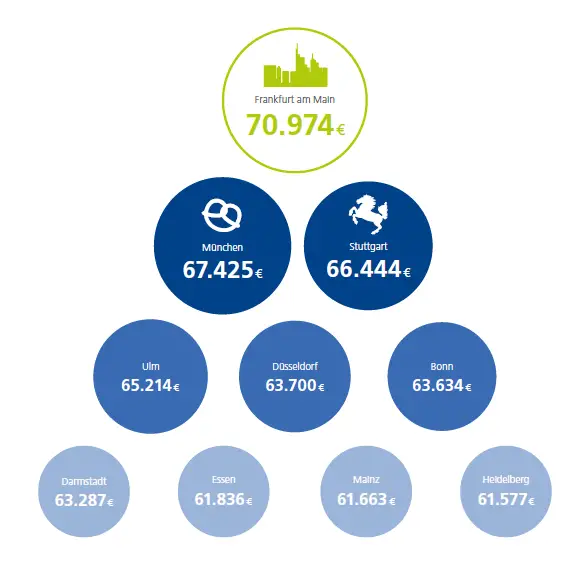
The top 10 cities with the highest average salaries in Germany are:

Machine generated alternative text:
/
63.287
¡
44
? Bonn
63.634t
Ìiit
Ç 61.577f

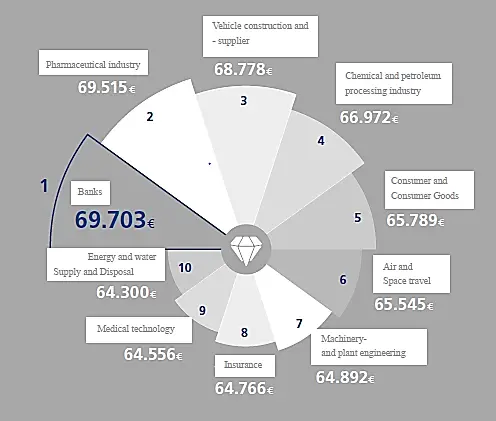
The top 10 sectors with the highest average salaries in Germany include: 

Machine generated alternative text:
PbazmaceuflŒl Í1K1us1y

The average salaries for professional groups:

OccupationAverage annual income (gross)
Doctor€ 92,316
Finance€ 76,354
Law€ 70,042
Banking€ 65,006
Engineering€ 64,541
Consulting € 63,893
IT€ 60,545
Marketing€ 60,424
Staff – HR€ 58,408
PR€ 57,741
Scientific research€ 56,466
Insurance€ 55,301
Purchasing, materials management & logistics€ 51,501
Education€ 50,352
Health and social services€ 49,866
Design € 48,259
Technical occupations€ 46,119

IT Industry Salary Structure in Germany

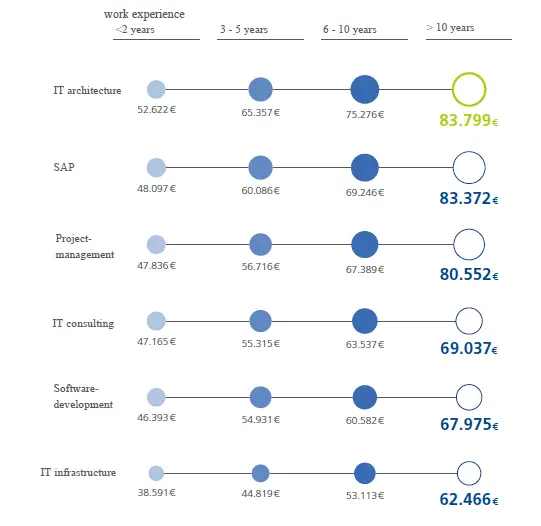
The average Salary difference for professionals in IT Industry based on tasks and professional experience is:

exp

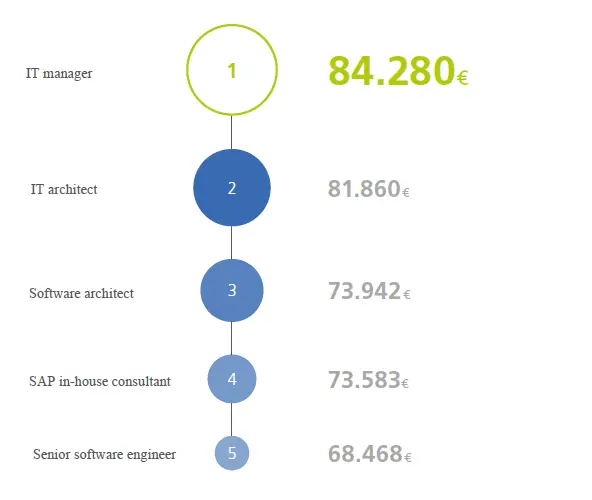
The top 5 Professional title in the IT Industry with highest average salaries are:

Machine generated alternative text:
IT manager
IT architect
84.280€
Software architect
SAP rn-house consultant
73.942
Senior software engineer
68.468f

Engineering Industry Salary Structure in Germany

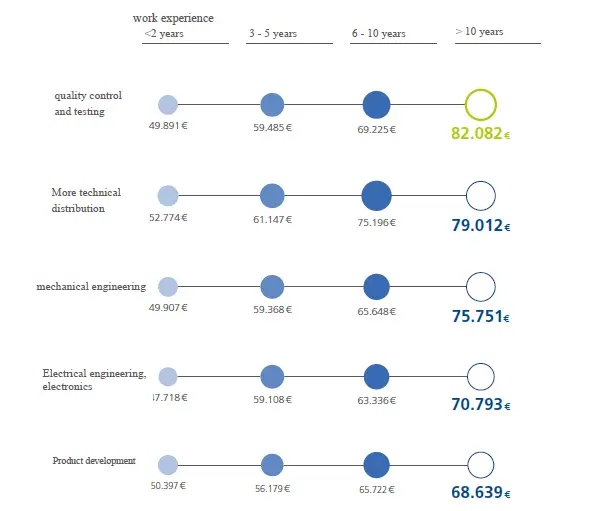
The average Salary difference for professionals in Engineering Industry based on tasks and professional experience is:

engexpe

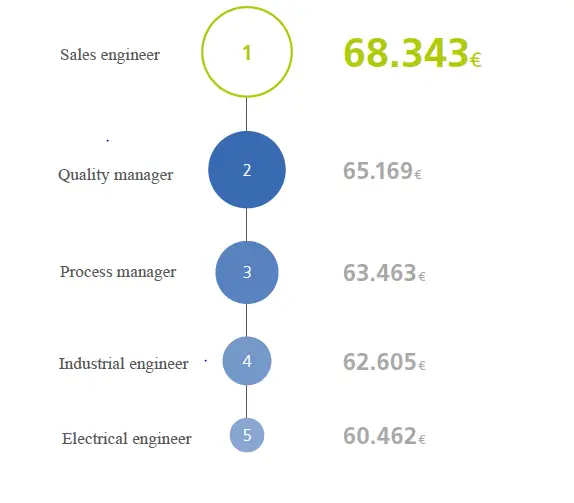
 The top 5 Professional title in the Engineering Industry with highest average salaries are:

Marketing Industry Salary Structure in Germany

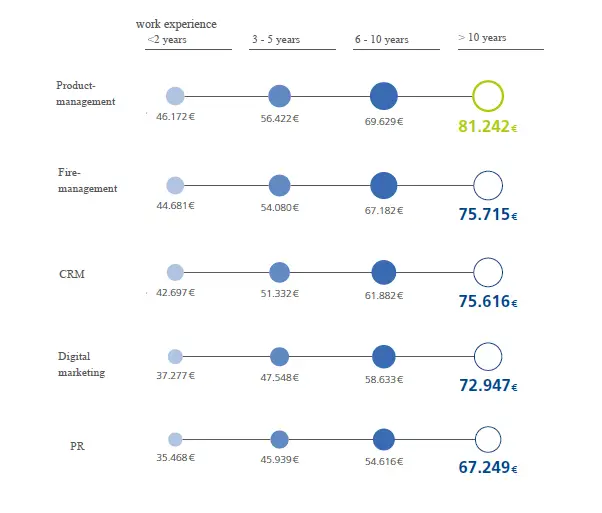
The average Salary difference for professionals in Marketing Industry based on tasks and professional experience is:

market

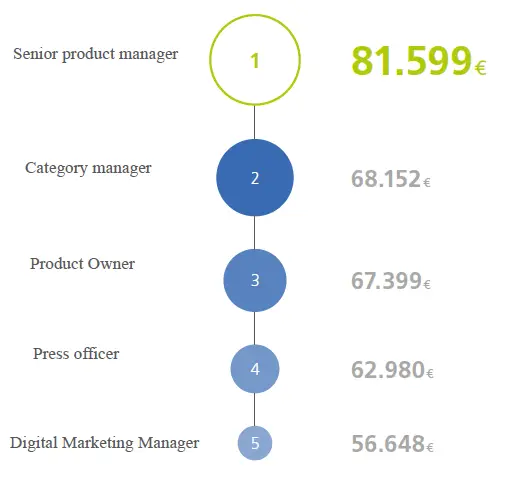
The top 5 Professional title in the Marketing Industry with highest average salaries are:

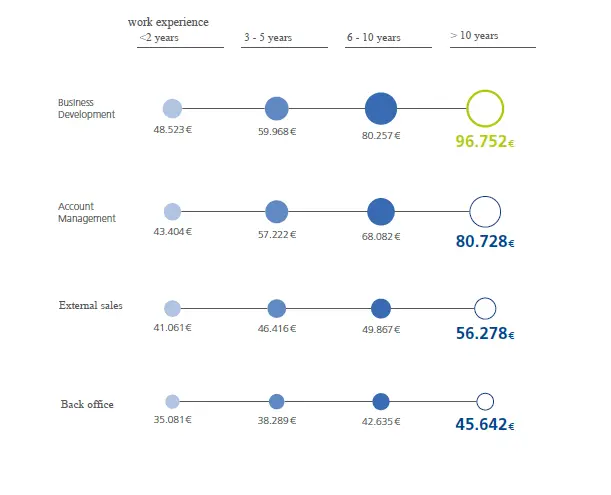
Sales Industry Salary Structure in Germany

The average Salary difference for professionals in Sales Industry based on tasks and professional experience is:

sales

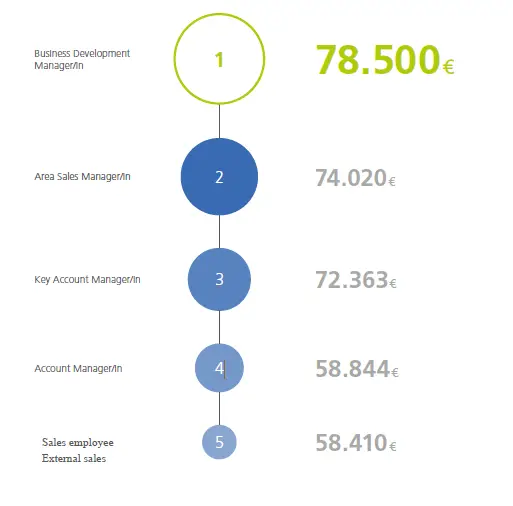
The top 5 Professional title in the Sales Industry with highest average salaries are:

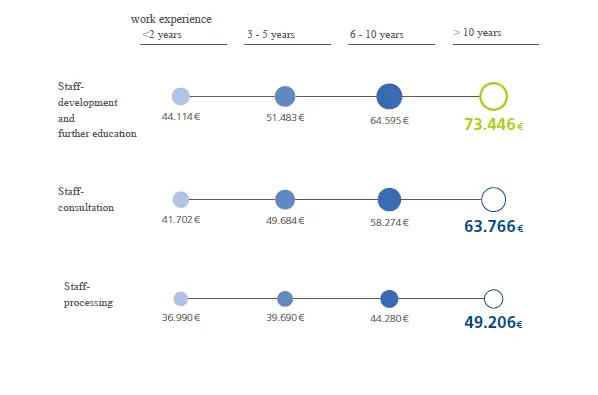
Personnel Industry (HR Staffing) Salary Structure in Germany

The average Salary difference for professionals in Personnel Industry based on tasks and professional experience is:  

personnel

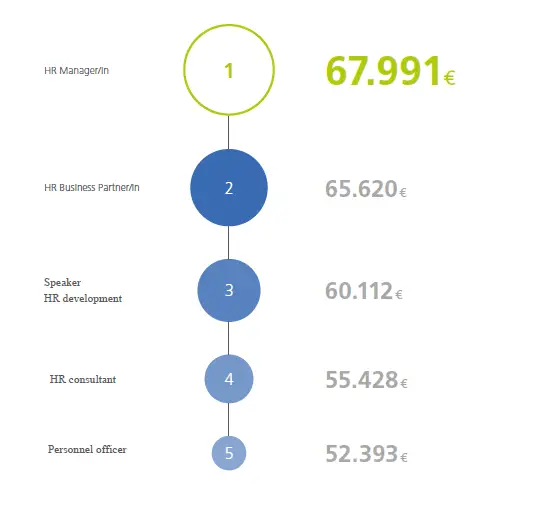
The top 5 Professional title in the Personnel Industry with highest average salaries are:         

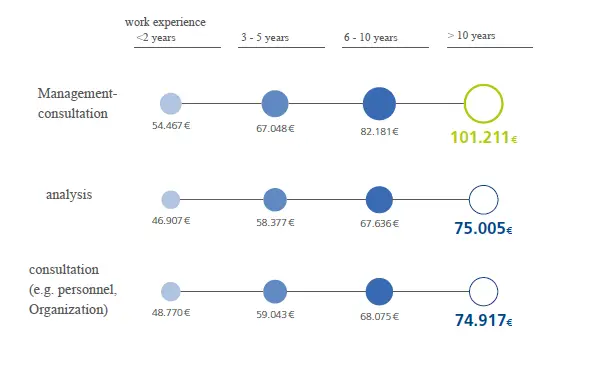
Consulting Industry Salary Structure in Germany

The average Salary difference for professionals in Consulting Industry based on tasks and professional experience is:  

consult

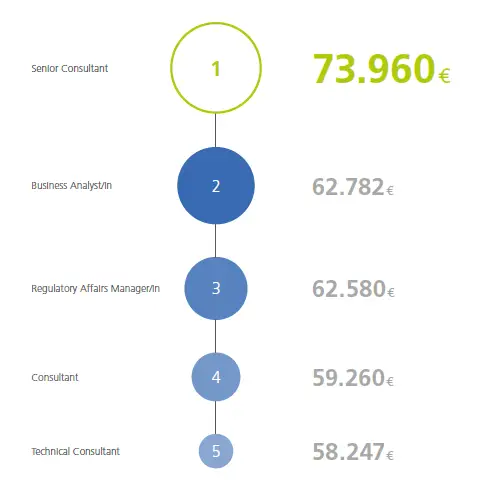
 The top 5 Professional title in the Consulting Industry with highest average salaries are:       

Machine generated alternative text:
senior Consultant
Business Analystiin
Regulatory Affairs Manager/in
73.960€
62.782
62.580€
ConsLdtant
59.260€
Technical Consultant
58.247€

Finance, Insurance and Banking Industry

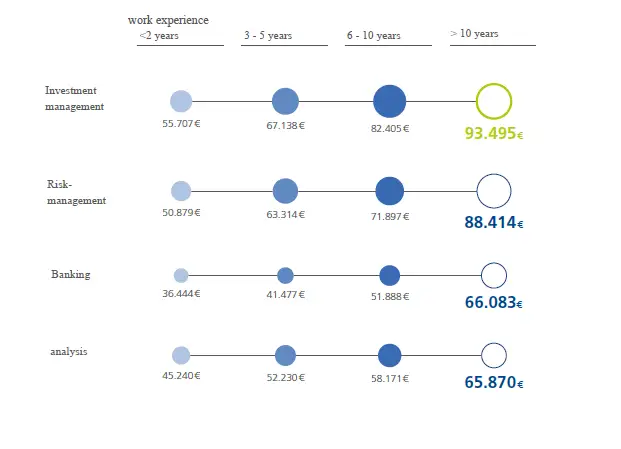
The average Salary difference for professionals in Finance, Insurance and Banking Industry based on tasks and professional experience is:  

Machine generated alternative text:
work experience
years 3 - 5 years 6 - lO years 10 years
55.707€ 67.138€
invernnent
management
Risk-
management
Banking
ana1vsis
50.879€
93.495€
63314€
36.444€
.-
45140€
88.414€
0
.
.
41477€
51.888€
66.083€
.
.
0
52.230€
58.171€
65.870€

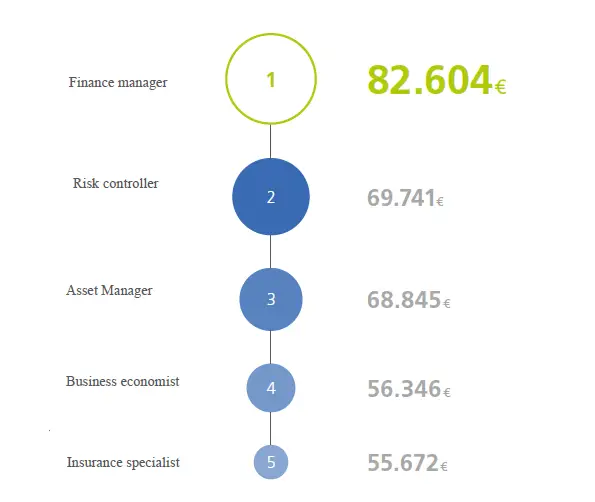
The top 5 Professional title in the Finance, Insurance and Banking Industry with highest average salaries are:                                                                                                                                                      

Machine generated alternative text:
Finance manager
Risk controller
Asset Manager
Business economist
69.741€
68.845€
56.346€
Insurance specialist
55.672€

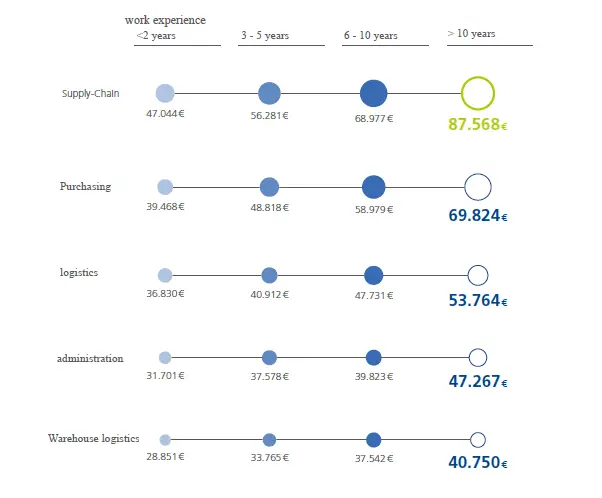
Purchasing and Logistics Salary Structure in Germany

The average Salary difference for professionals in purchasing and logistics Industry based on tasks and professional experience is:  

Machine generated alternative text:
work experience
.:;2 years 3-5 yeai 6- 10 year5 10 years
Supply-Chain
47.044€ 56.281€ 87.568
Purding (D
39468€ 48818€ 58.979€ 69.824€
1ogist1c
36.830€ 40912€ 47.731€ 53.764€
admiiitratiou Q
31.701€ 37.578€ 39.823€ 47.267€
Warehouse logistes •
28.851€ 33.765€ 37.542€ 40.750€

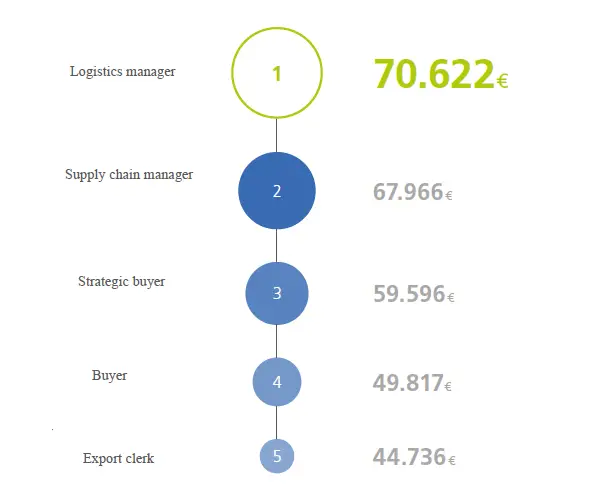
The top 5 Professional title in the purchasing and logistics Industry with highest average salaries at a glance are:

Machine generated alternative text:
Logistics manager
Supply chain manager
Strategic buyer
70.622€
67.966f
59. 596f
Buyer
49.817
Export clerk
44.736

Work in Germany – A comprehensive handbook to begin

Work in Germany

Germany is currently competing with other well-known expat destinations, such as Canada and New Zealand, to attract the best of skills. Therefore, is working particularly hard at competing with these countries to be seen as an attractive place to live and work by providing the flexibility of short working hours, plentiful vacation, and public holidays.

The Skilled Immigration Act, which entered into force on 1 March 2020, has put new rules in place which make it easier for foreign qualified professionals to come to Germany. The Skilled Immigration Act amends both residence rules and rules set out for the Employment of Foreigners to facilitate the successful recruitment of skilled workers from abroad.

Graduates and skilled workers with vocational qualifications from outside the EU will now enjoy access to all occupations in which workers are being sought as long as they have a comparable qualification which can be used and to work in Germany.

[rb_related title=”Also interesting” total=”2″]

These terms cover the following groups of people:

  • Persons who have successfully completed an academic or vocational course
  • Trainees and advanced students
  • Persons with qualifications going through procedures to recognise their qualifications
  • Experts and specialists with practical job-related expertise

In line with the Freedom of Movement Act/EU, nationals of the EU and the EEA enjoy unrestricted access to the German labour market. These same rules apply to Swiss nationals. So, they do not need a visa or a residence permit to take up employment in Germany.

The nationals of Australia, Canada, Israel, Japan, the Republic of Korea, New Zealand and the United States of America can enter without a visa and can obtain the necessary residence permit for the taking up of employment from the relevant foreigners registration office in Germany once they have arrived in the country and can start working as soon as they receive the residence permit. But, it may still be worth applying for the visa to work in Germany before you come. If this is done, the person can start working as soon as they arrive in Germany.

Nationals of all other countries (called “third countries”) require a visa to enter Germany and which must be converted into a residence permit once they are in Germany so that they can live and work in Germany.

Many qualified professionals from abroad find it difficult to look for employment from third countries. The lack of proximity to German firms is a big disadvantage for them.

In order to facilitate the matching between job seekers from abroad and the employer, skilled workers can be granted a visa for the purpose of finding a job if they meet the following requirements:

  • The qualification obtained abroad is recognized in Germany or is comparable with a German qualification.
  • They are able to maintain themselves in Germany.
  • More details can found here

This visa or the residence permit is issued for a maximum of six months and cannot be extended for this purpose. If you succeed in finding a job, the residence permit to take up employment can be applied for from the relevant foreigners registration office without leaving Germany. The employment then can be commenced, once this residence permit has been issued.

If you possess the visa or residence permit for the purpose of seeking employment, you are permitted to take up employment for up to ten hours a week.

As a qualified professional your route of immigrating to Germany to continue your career envelops a number of factors including:

  • Professions in Demand
  • Recognition
  • Job Application
  • Work Contract

Professions in Demand for Work in Germany

According to German economic research companies, Germany faces a shortage of skilled workers in a number of professions. These categories include the Healthcare Sector, IT Sector and mathematicians.

With a steady economic growth and a low employment rate, Germany also offers well-paid designations in banks, insurance firms, software and security companies.

Such designations include:

  • Nursing professionals
  • Physicians
  • Engineers
  • Scientists
  • IT Specialists
  • Vocational Teachers – English

Recognition for Professions to work in Germany

Professionals belonging to Germany’s Regulated Professions, such as nurses, doctors, teachers, and lawyers, require Recognition of their foreign qualifications or professional licenses in Germany before beginning work.

A complete list of the regulated professions can be found on the Regulated Professions Database or you can assess if your profession is regulated or not through the Recognition Finder.

A recognition to work will not be required, if you want to work in an academic, Non-Regulated Profession, such as computer scientist, mathematician or economist. However, it is advisable to apply for a verification of equivalency that can increase your chances on the German job market.

The complete recognition process can be found through Recognition in Germany.

Job Applications

Job Applications in Germany necessarily mandate the use of Cover Letters with CVs. It is highly advisable to include well designed formatted cover letters describing your strengths, explanatory interest in the profile, and presentation of why you are an ideal candidate.

The Curriculum vitae, for your job application in Germany, must always enlist your Personal details, Professional Experience in chronological order, Education, Language Skills, and your interests.

Mostly, there are set formats for the formal design of the CV to be presented in the labor market, which can be found on The Europass.

Work Contract

After you procure a job, the first thing in order is Congratulations!

The next is obviously the work-contract. A better insight of these contracts can be found in the ‘Contracts of Employment‘ section of our article German Laws and German Legal System.

German laws and German Legal Systems

German legal system

A common but less addressed issue for the expatriates is the coming to terms with the differences in the legal systems between their mother country and the German legal system. It is always important to familiarise yourself with the regulatory arrangement of the country you reside in. It is always useful to understand the type of contracts you might enter in from renting apartments to selling cars or regarding the differences relating to German employment law, workplace rights and Labor Law that have a direct effect on the your rights in full or part time employment.

The German Legal System provides a safeguard to ensure the objectivity in contract agreements and investigations.

Basic Rights

The German Constitution is referred as the Basic Law for the Federal Republic of Germany (Grundgesetz für die Bundesrepublik Deutschland ) which implements the separation of powers and binds the executive and judiciary powers by law and justice.

Contract Structures

In Germany, you might not find contracts with detailed information that puts everything on the paper you sign. Instead, the specifics are broadly covered by the German Laws. This is a way to control the unfair and unlawful exploitation of both parties bound by the contract.

House/Apartment Rental Agreements

The contract agreements can be temporary, fixed term or indefinite. They would usually be concise without details on lease dealing, notice periods or renovation requirements as these would be covered by the German Legal System.

And, because of no specific rules regarding the form of the rental agreement, an indefinite rental agreement (“unbefristeter Mietvertrag”) is the most common type of rental agreement used in Germany. It can be simply agreed upon orally which could be problematic in the long run.

It is therefore recommended for expatriates to have an open conversation about leasing and conditions with the owner and demand a written agreement based on discussions in case of no written agreement being provided with at least:

  • Names and addresses of both parties,
  • Start date and length of the lease agreement
  • Amount of rent and utility expenses
  • Terms of payment
  • Description of the rented premises (e.g. number of rooms, parking space, garden etc.).

Indefinite Rental Agreement

Any rental contract that is agreed upon orally or for a period of more than a year is assumed to be indefinite.

Termination of contract by the landlord can be by either providing legitimate reasons, for example, non-compliance with the terms and conditions of the contract by the tenant, or if the landlord needs the property for himself or his family. This is known as ordinary termination of contract (“ordentliche Kündigung”) or by giving a good reason to do so such as improper use of property by the tenant or unpaid rent for more than 2 months. This is known as extraordinary termination of contract (“außerordentliche Kündigung”).

Both of these types of termination should be given with appropriate period of advanced notice and as a written statement, noting the specific reasons for terminating the contract.

If the tenant wishes to terminate the contract, he must send written notice to the landlord with a three-month period of advanced notice.  For ordinary termination of the contract (“ordentliche Kündigung”), the tenant is not required to give reasons.

But, in exceptional circumstances such as dangerous living conditions or unavailable property, the tenant has the right to terminate the contract without the 3-months advanced notice with clearly specifying the reasons for termination in a written statement that is given to the landlord.

It is important to note that only the person(s) bound by the contract have the right to terminate it. If there are several landlords or tenants, the termination notice must be signed by all landlords and addressed to all tenants or vice versa.

Fixed Term Contracts

This is the less popular version of rent agreements in Germany (except for student rooms, furnished rooms, or rooms used for a temporary period).

A fixed-term leasing agreement is only be signed, if the owner wishes to either use the property for himself after the end of the contract (“Eigenbedarf”), has to make substantial changes to the property or lease the premises for professional purposes which makes renewing the contract impossible.

A fixed-term rental agreement cannot be terminated before the end of its term, except under extraordinary circumstances. It may still be possible from the landlord’s side but includes an advance notice.

There is no obligation to renew the fixed-term contract, but 4 months before the end of the contract, the tenant is entitled to request an indication from the landlord about whether the lease agreement will still be terminated at the previously agreed upon date and the landlord should get back to the tenant within 1 month following this request. If there is no valid reason for terminating the contract, the tenant is entitled to request the extension of the contract.

Contracts of Employment

Under the Documentary Evidence Act (“Nachweisgesetz”), an employer is required to lay down the terms and conditions of the employment relationship no later than one month after the commencement of the employment relationship and shall at least contain the following information:

  • Name and address of the parties to the contract
  • Date of the commencement of employment
  • For term based employment – the duration of the employment relationship
  • Place of work or an indication of transfers to different locations
  • Description of the job
  • The compensation breakup and the Salary due date
  • Holiday entitlement
  • Working hours
  • Notice perios for the termination of the employment relationship
  • Reference to labour agreements, company or service agreements being applicable to the employment relationship.

German Laws such as the Minimum Wage Act (€9.35 gross per hour since 1 January 2020), the Federal Vacation Act (20 vacation days per year for a five-day working week) etc. set the minimum terms and conditions for employment in Germany.

The other important employment laws of the German Legal System include:

  • The Civil Code.
  • The General Equal Treatment Act.
  • The Part-Time and Limited Term Employment Act.
  • The Continuation of Remuneration Act.
  • The Minimum Wage Act.
  • The Protection Against Unfair Dismissal Act.
  • The Minimum Vacation Act for Employees.
  • The Works Constitution Act.
  • The Hours of Employment Act.
  • The Maternity Protection Act.
  • The Federal Parental Benefit and Parental Leave Act.
  • The Labour Court Act.
  • The Act Regulating the Commercial Leasing of Employees.
  • The Act on Documenting Essential Applicable Conditions for Employment Relationships.

The notice periods are set forth in the German Civil Code (“Bürgerliches Gesetzbuch”) which represent the statutory minimum for dismissals and apply if the contract does not provide for any specific notice periods. These are proportionally dependent on the years of employment and range from one to four months.

In case of litigation between the parties of an employment relationship the following courts or tribunals have jurisdiction to hear employment-related complaints.

  • The labour courts:  one professional judge and two honorary judges
  • The higher regional courts: one professional judge and two honorary judges
  • The federal labour court: three professional judges and two honorary judges

Attorneys

There are numerous private Law Firms specializing in the advising of Expatriates residing in Germany. Even if knowing your rights and legal entitlements is covered navigating through the intricacies of the German legal system can be a hugely stressful and complex task. That is why, it is wise to have a legal representation unless a case is minor or the charges are undisputed.

The right to be represented by counsel is carefully protected under German law. In some cases, German law even mandates the provision of counsel even if someone doesn’t wish for it.

Clarity regarding fees is highly important thus you should immediately discuss the costs of possible legal actions, or of filing a lawsuit or complaint (legal fees, attorney fees, court fees etc.) before the relevant Court of Justice.

If the accused in criminal cases is acquitted, the court generally pays the attorney’s fees.

In case of litigation processes it is advisable to discuss the relevant deadlines, such as the crucial 3 weeks deadline after delivery of the termination notice in case of employment.

In a German trial, the judge and not the defense lawyer or the prosecutor, obtains the testimony of the witnesses. After the judge is finished, the prosecutor and the defense counsel are permitted to question witnesses.

Courts and Judges

The judicial system in Germany is established and governed by the Basic Law of the Federal Republic of Germany. The establishment is particularly of two types:

German Ordinary Courts

The German ordinary courts usually rule in criminal and civil matters such as marriage and family disputes and other non-contentious cases

The ordinary courts in Germany are organized as:

  • Local courts (Amtsgerichte)
  • Regional courts (Landgerichte)
  • Higher regional courts (Oberlandesgerichte)
  • The Federal Court of Justice (Bundesgerichtshof).  

Local and regional courts serve as the first instance courts, while the Higher Regional courts and the Federal Court are appeal courts. The District Court is the one that hears cases in which the dispute has a value of over 5,000 euros.

German Specialized Courts

The German specialized courts are divided into:

  • Administrative courts: dealing with wrongful administrative acts that can refer to how the government has treated citizens.
  • Labor law courts: cases involving employment disputes, collective bargaining agreements or workers compensation claims.
  • Financial courts: these specialize in tax-related litigation, for example, disputes between taxpayers and the tax authorities.
  • Family Courts: deal with family and marriage matters, child custody or child-parent matters as well as adoption and alimony rights.
  • Probate Courts: they issue inheritance certificates as well as handle matters concerning the enforcement of wills and other inheritance issues.
  • The Federal Patent Court: this court hears cases involving trademarks, patents and generally intellectual property cases.

The Federal Constitutional Court (Bundesverfassungsgericht) is the highest court in the German judicial system. It rules in constitutional matters and has contributed to the development of the Federal Republic of Germany.

It is important to note that there is no jury trial in Germany as Article 92 of the Basic Law states that “the judicial power shall be vested in the judges” therefore the judges take the active role in court proceedings.

Healthcare System in Germany – Complete Explanation for Better Relocation

healthcare system in Germany

The healthcare system in Germany is excellent, but the familiarity with the substructure is one of the most important checkboxes you need to tick in your relocation checklists before planning that move. This helpful guide will cover the basic information you need about the healthcare system in Germany.

  • Overview of the healthcare system in Germany
  • Health insurance in Germany
  • Healthcare costs in Germany
  • Registration for healthcare in Germany
  • Hospitals and Pharmacies
  • Healthcare for Women
  • Dental Insurance
  • Emergency Services

Overview of the healthcare system in Germany

To begin with, all Germans and legal residents of Germany are entitled to free “medically necessary” public healthcare, funded by their social security contributions. However, citizens should still have either state or private health insurance cover for hospitalization, outpatient medical treatment, and pregnancy. It is legally mandatory for everyone in Germany to have health insurance coverage whether public or private depending on their incomes.

The development of Health Policies in Germany is done by the Federal Ministry of Health and the sector is regulated by the Joint Federal Committee.

The healthcare plans in Germany are divided into two sectors – Public Healthcare System i.e. Government’s Healthcare Plans and Private Healthcare System

Public Healthcare Scheme (gesetzliche Krankenkasse, GKV)

The public healthcare system in Germany covers treatments and services, such as immunizations, prescriptions, and dental checks across the country. This sort of national coverage facilitates low average healthcare costs in Germany contributing as an effective healthcare system in the world.

Public Health Insurance Costs in Germany

Salaried workers in Germany with gross monthly income less than 5,213 EUR and gross annual income less than 62,550 EUR as of 2020, must have public health insurance.

Even if you earn more than 62,550 EUR, you can continue with the public health system, as a voluntary user and agree to pay the maximum premiums.

Germany’s healthcare contribution costs are 14.6 to 15.6% of the total income, which equally split between the employer and the employee. An additional “Contribution rate” is charged by the state German health insurer at an average of 0.9%, paid solely by the employee.

Non-working dependents living at the same address and registered with the German Authorities are covered at no extra cost. Pensioners and people who receive unemployment benefits or assistance are also eligible for state healthcare.

Public Healthcare Registration

Generally every employer will register you with a regional German health insurance company. You are free to choose the insurer of your choice, and can do so by informing your employer within a definite period of starting work.

In other cases, when you need to arrange your own German health insurer you simply need to register with the German authorities at your local town hall. Factors to consider before opting are the insurer’s contribution rate, additional services, ease of contact, or availability of English-language information.

Once you’re registered with a social security number and begin your premium payments, you will have access to public healthcare with your health insurance card (Krankenversichertenkarte).

GKV maintains the list of all state German insurance companies to compare health insurance rates.

Public Health Insurance Coverage in Germany

The Public Health Insurance covers you for primary care with registered doctors, hospital care (in and out), and basic dental treatment.

Public Health Insurance however does not cover consultations with private doctors, private rooms in hospitals, alternative or complementary treatments such as dental implants, glasses/contact lenses for adults.

Private Health Insurance Scheme (Private Krankenversicherung or PKV)

The Private Health Insurance Scheme is limited to a set of people, you are only eligible to apply if you fall in the below criteria list:

  • An employee earning more than 62,550 EUR annually as of 2020
  • Self-employed
  • Working part-time and earning less than 450 EUR a month
  • freelance professional
  • Artist
  • A civil servant or certain other public employees

Private Health Insurance Costs in Germany

Unlike State Health Insurance which are priced based on your income the private health insurance costs are rather risk and patient profile based which might increase with age, health risks and added family members.

If you are eligible for private insurance, you can change from public to private health insurance but, you have to opt-out of the State health insurance first—you cannot have both.

Private health insurance entitle you to services and facilities not covered by public scheme, such as private healthcare, private hospital rooms, dental implants and complementary therapies.

Private Healthcare Registration

The application process for private health insurance is quite complicated as it might require you to take medical tests, answer questionnaire concerning your medical history and submit a proof of income.

Most private insurers in Germany require you to pay medical costs upfront and then claim reimbursements, whereas public insurance usually covers everything upfront through your social security contributions. 

The health insurance costs from private providers widely varies according to profiles, you can compare private health insurance providers in Germany on this website PKV.

Some of the top private insurance providers contact can be found through the list of members of PKV

It is mindful to always inquire which treatments and hospitals do your insurance company cover with the cost coverage percent as Co-payments have been increasing for certain treatments and medicines in Germany. In some areas such as dental, orthodontic treatment, and optical care, state health insurance only covers a small portion of the cost.

Hospitals

All the German states share responsibility with the central government for hospital provision in the Healthcare system in Germany.

There are three types of hospital (Krankenhauser) in Germany:

  • Public hospitals (Offentliche Krankenhauser) – run by local or federal state authorities. These include Germany’s university hospitals. Most number of hospitals in Germany are Public Hospitals.
  • Voluntary charitable hospitals (Frei gemeinnutzige Krankenhauser) – run by churches or German Red Cross organizations.
  • Private hospitals (privatkrankenhauser) – run by private companies.

You should take your German health insurance card when you visit. Generally, the hospitals in Germany charge a daily fee of about 10 – 15 EUR with additional costs for diagnostics, surgery, and other medical procedures. Children aged under 18 years of age do not have to pay any costs.

It is important to note that hospitals have a certain amount of definite space allotted to patients with public insurance and with private insurance but the medical treatment for both public and private insurance holders is almost identical. Patients with private healthcare can demand to be treated by one of the hospital’s chief doctors and there are some private clinics that are open only to patients with private health insurance.

Hospitals in Germany do not provide personal items. You would be required to bring your own bathrobe, toiletries, and slippers.

German websites like DocInsider.de and Jameda.de can be of assistance to find doctors based on ratings from other patients.

Pharmacies and Medication

Prescription and non-prescription drugs can be easily obtained at pharmacies (Apotheken) and can refer this to search for local pharmacies.

Patients enrolled in the public health insurance scheme (with prescription on a pink slip of paper) have to pay only 10% of the costs i.e. about 5-10 EUR.

Private Insurance holders mostly get prescriptions on a blue sheet of paper which requires them to pay the full price of the drug up front and then send the receipt to your insurance company for reimbursement.

Healthcare for Women

Gynecologists are accessible in Germany through public health insurance. Public health insurance doesn’t cover most contraception costs.

Statutory insurance covers annual screenings for every woman aged over 20 for cervical cancer, breast cancer, and ovarian cancer.

State health insurance also covers the basic costs of pregnancy and childbirth. However, additional costs may be applicable for the paperwork involved in giving birth.

Private health insurance holders in Germany should check with the insurer for details about medical care for mother and baby.

Healthcare For Children

Public health insurance covers children until the age of 18. Vaccinations for children in Germany are free.

Dental insurance in Germany

If you have state German health insurance, simple routine dental procedures (filling, dental hygiene) or dental emergencies are more likely to be covered with the dentists who operate within the statutory health insurance scheme.

Otherwise, dental work in Germany can be quite expensive, and would often require you to present a cost estimate to your insurance provider prior to getting treatment.

The coverage for dental work varies greatly depending on the procedure and the individual.

There is additional private health insurance available for dental treatment. This is usually presented as a top-up insurance option called Zahnzusatzversicherung or Zahnschutz-Zusatzversicherung.

Emergency Services

The primary responders in Germany for emergencies are – Emergency Medical Services (Rettungsdienst), Fire Services (Feuerwehr) and the police (Polizei).

Pan European Emergency Number – 112

Police – 110

Ambulance (Rettungswagen or Krankenwagen) – 19222 

Non-emergency medical (doctor on call): 116 117 you can also visit the website for further details.

To find an emergency pharmacy call 0800 002 28 33 from a landline or 22 8 33 from a mobile.

Useful phrases:

Call an ambulance!: Rufen Sie einen Krankenwagen!

It’s an emergency: Es ist ein Notfall/dringend.

I’m in pain: Ich habe Schmerzen.

I need a doctor: Ich brauche einen Arzt.

I need a hospital: Ich brauche ein Krankenhaus.

There’s been an accident: Es gab einen Unfall.

Cost of living in Germany – Practical and efficient financial planning to consider before moving

Cost of Living Calculator

With one of the most highly developed social market economy, the actual cost of living in Germany is rather comfortable and settling for expats in comparison to its European brethren. As a matter of fact, the cost of living in Germany is almost as laid back as 10% in comparison to UK, France, Norway or Switzerland – other popular countries to settle in.

How much exactly would you need then, you ask?

Well, this question is very much dependent on the lifestyle you choose to spend on. Your requirements would mostly govern your budget, but the good thing is that Germany offers you a range of monthly expenditure beginning from 900 EUR to any number you can willingly afford

  • Accommodation (including and excluding utilities)
  • Grocery Expenses
  • Transportation
  • Healthcare
  • Dining out
  • Internet and mobile provider
  • Taxation

Except for the high end expenses, the cost of living can be determined based on the below mentioned factors to sustain a certain standard of living:

 This article would provide an overview of the average costs for the above mentioned factors based on estimates for an individual. The item dependent pricing will be elaborately mentioned for making it easier for you to shortlist them according to your suitability and give you a clearer insight about your personalized monthly budget.

Accommodation

The first, foremost and largest expense in the cost of living is the housing budget. Though, it will vary according to the cities you decide to stay in and will be heavily dependent on the size and location of the property, we still present you the average costing for the most popular cities in Germany.

Cost of living in Germany
Finding Accomodation

Berlin

One of the most chic hangouts in the world. This city is the most popular city with expats in Germany.

Rent400 EUR800 EUR1,500 EUR
Room typeSingle Room in shared apartmentApprox. 50m² 2 bedroom apartmentApprox. 100m² 3-4 bedroom apartment
Berlin
Berlin Tower

A single room in a shared apartment can begin at around 400 EUR and can be as much as 600 EUR per month. For a 2 bedroom apartment in a decent neighborhood and good location, the rent might average least 800 EUR including costs for water and heating. There can be additional expenses for the internet, TV, and electricity adding 100 EUR.

Hamburg

Hamburg is the second biggest city in Germany and interestingly boasts of more living space per person than all the other major cities in the entire world!

Rent370 EUR900 EUR1,800 EUR
Room typeSingle Room in shared apartmentApprox. 50m² 2 bedroom apartmentApprox. 100m² 3-4 bedroom apartment
hamburg
Hamburg

Hamburg is the second most expensive city in Germany and the cheapest accommodation offered is in terms of shared rooms and rents. Flats and apartments begin at around 900 EUR and can go as high as 2000 EUR based on the size and location including utilities.

Munich

Munich easily showcases a large international community making life a lot easier for expats but at a higher cost.

Rent600 EUR1,200 EUR2,000 EUR
Room typeSingle Room in shared apartmentApprox. 50m² 2 bedroom apartmentApprox. 100m² 3-4 bedroom apartment
Munich
Munich

A single room in a shared flat will roughly cost 600 EUR and can escalate up to 900 EUR per month, more expensive in comparison to other cities. For an apartment with 2 rooms in a good neighborhood, you need to shell out at least 1200 EUR. A flat with 3 or 4 rooms and a separate kitchen can easily cost you 2000 EUR or more with dependent on location.

Nuremburg

Another impressive but a more relaxed option which offers a great lifestyle within your budget in Germany is Nürnberg (also known as Nuremburg).

Rent300 EUR700 EUR1,200 EUR
Room type Room in shared apartment50m² 2 bedroom apartment100m² 3-4 bedroom apartment
Nuremberg

Frankfurt

As Germany’s financial capital, it’s a fairly expensive city to live in, with monthly rent averaging over 1600 EUR for a flat with utilities.

Rent500 EUR1000 EUR1,600 EUR
Room typeSingle Room in shared apartmentApprox 50m² 2 bedroom apartmentApprox 100m² 3-4 bedroom apartment
frankfurt
Frankfurt

Grocery Expenses

The common single individual’s grocery consumption is estimated at around 50 EUR to 60 EUR per week but is again very much conditioned upon the taste and preferences of individuals.

Below listed is the typical pricing for essentials to let you customize your own weekly expenditure.

ItemQuantityPrice
Water1.5 litre0.43 EUR
Milk1 litre1.20 EUR
White Bread500 g1.34 EUR
White Rice1 Kg2.99 EUR
Regular Eggs1 dozen2.00 EUR
Local Cheese1 Kg8.32 EUR
Regular fruits1 Kg3.00 EUR
Regular Veggies1 Kg1.00 to 2.00 EUR
Chicken1 kg5.96 EUR
Beef Round1 Kg10.78 EUR
Wine (Mid-range)1 Bottle4.99 EUR
Domestic Beer0.5 litre0.84 EUR
Cigarettes20 pack6.40 EUR

Transportation

Moving around in Germany is usually by local trains, metro, trams, and buses. Germany also provides the flexibility to rent bikes on an hourly and daily basis. App-based cab services mostly operate in only some big cities. But, do not let it discourage you as there’s hardly any inconvenience because of the efficient public transport and hail taxi system.

Also, please visit the precise guide that helps when you move to Germany at GoTravelYourself. And it has helpful guides to travel around the Europe

Public transport:

A single ticket for public transport would cost you 2.8 – 3.4 EUR depending on the area. The tickets can be bought for individuals and groups (with discounts).

1 day ticket would cost you approximately 7 – 7.7 EUR

7-day ticket would be about 30 – 37.5 EUR

Taxis:

Taxis round to about 3.00 EUR fixed charge with addition of about 1.50 EUR per km and waiting charges of almost 30.00 EUR per hour.

Bikes:

A 2 hour rental would cost you about 6 – 8 EUR, going up to 10 EUR for 4 hours. Daily rental charges would be in the range of 12 – 14 EUR.

InterCIty Transportation:

The most prevalent express trains in Germany are the Deutsche Bahn – super-fast InterCity Express (ICE) trains. They zoom around the country at hourly and two-hourly intervals and link up all major cities.

The ticket pricing varies for different destinations but there are attractive discounts for short journeys and groups.

There are also three BahnCards offering reductions.

  1. “BahnCard 25” – In which, you need to pay only three-quarters of the ticket price,
  2. “BahnCard 50” – Pay half the ticket price
  3. “BahnCard 100” – Simply pay the price of the card and nothing else.

Healthcare

Public healthcare

In Germany, every employed worker has to pay a statutory healthcare insurance contribution as part of their social security contribution.

Contribution by employee = 7 to 8% of total income.

Contribution by the employer = additional 7 to 8% of employee’s income

Total contribution = 14-16%

The maximum amount is capped at EUR683 (inclusive of both employee and employer’s contribution) a month.

Private Healthcare

Private healthcare is limited to only a set of individuals including freelancers, students over the age of 30, people earning less than 450 EUR, or earning more than 60,000 EUR.

As, the cost of private health insurance not regulated by the government, the expense mostly depends on insurance companies’ monopoly.

This creates an anomaly as for people deemed as low-risk patients, the premiums could be around 170 EUR whereas for high-risk patients or older people this could mount up to 1500 EUR per month.

Dining Out

Dining out can range between 8.00 EUR – 9.00 EUR for a meal at popular fast-food chains without discount coupons. But, a full three-course meal at a regular restaurant would cost you 12.00 EUR and go up as high as 25.00 EUR.

  • A piece of cake = 3 – 5 EUR
  • A pastry = 1.2 – 2 EUR
  • A croissant = 1.2 EUR
  • Pizza = 7 – 10EUR
  • Ice cream dessert = 6 – 7 EUR

Internet and Mobile

Prepaid phones offer good flexibility since you pay as you go. As you need more credit you simply buy recharge cards. The minimum amount of credit that you can add is usually EUR 5-10. And a minute of Prepaid Mobile Tariff (No Discounts or Plans) would cost you around 0.10 EUR.

The other option is a contract phone. These do offer lower calling rates and better deals on new phones but these prices can be estimated on the basis of your need, the monthly fee, the connection cost, and the minimum monthly consumption.

It is not really common in Germany to get data plans with unlimited mobile internet. Presently, there are two providers namely Telekom and O2, which offer unlimited data plans. The cheapest unlimited data offer is provided by O2 for 39.99 EUR per month and Telekom is a little bit on the expensive side mounting to 84.95 EUR/month.

Taxation

 One another important aspect to include in your cost of living expenses is the taxation.

This would vary for individuals depending on their source of Income. It is advisable for you to go through the latest tax summaries to understand your tax rate and estimate your total cost of living in Germany accordingly.

You can refer the Complete guide to getting a Tax ID in Germany for a comprehensive insight of how to get started as a newcomer in Germany.

A detailed guide on German tax system can be found on Bundeszentralamt für Steuern .

Even if these numbers look a bit under or overwhelming, It is very important to remember they only provide the comprehension of a personal budget to form an overview of the financial planning required and are definitely not the guidelines to live by!